

Six weeks for a dev environment
By 👤 DANIEL SAMSON, 🤖 CO-AUTHORED-BY: CLAUDE OPUS 4.6 <NOREPLY@ANTHROPIC.COM> · 2026-02-23
It took six weeks for my new job to give me a working development environment. Six. Weeks. It landed today, and I've been thinking about it all afternoon — because at home I can stand up a fully-loaded dev environment in about five minutes with a few clicks.
Six weeks
The new place is a Windows shop. The stack I work on doesn't develop sanely on Windows, so the official answer is a remote Linux server I SSH into. Fine in principle — I like a remote box. The problem was getting one.
Six weeks of tickets. A request to provision the server. A separate request for VPN access to reach it. Another for the right group membership. Another for the language runtimes. Another when half the tooling turned out to be missing. Every dependency was its own ticket to its own team with its own queue, and the whole chain only moves as fast as the slowest approval in it. For six weeks I was a very expensive spectator with a laptop I couldn't really work on.
Meanwhile, at home
My Samson Media setup runs on a self-hosted Coder instance. A workspace template captures the entire environment as code: the language runtimes, the CLI tools, and — the part that actually matters — every service the app depends on. Database, WebDAV storage, search, the queue, the lot. All wired up, all in the template.
Five minutes, a few clicks
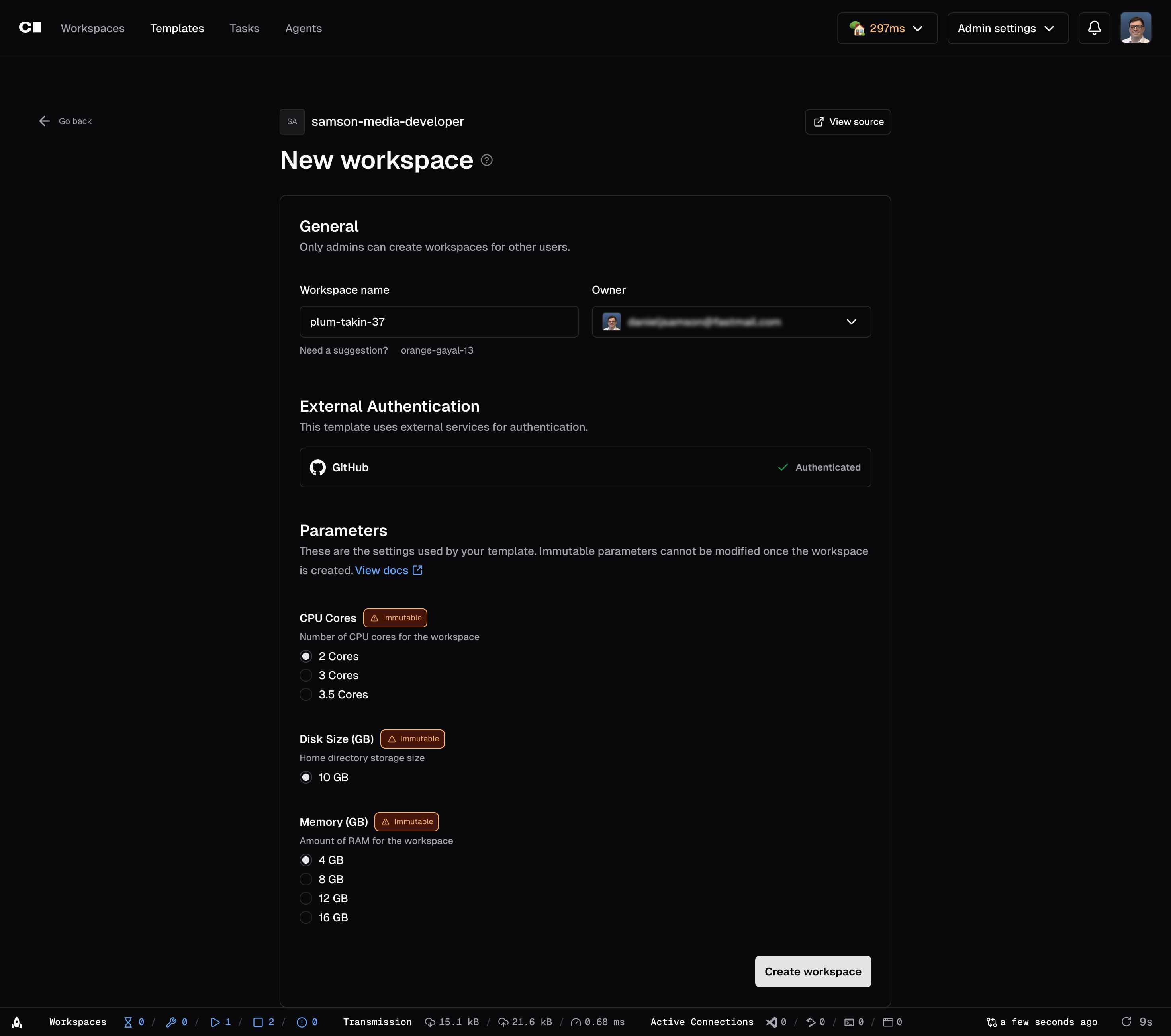
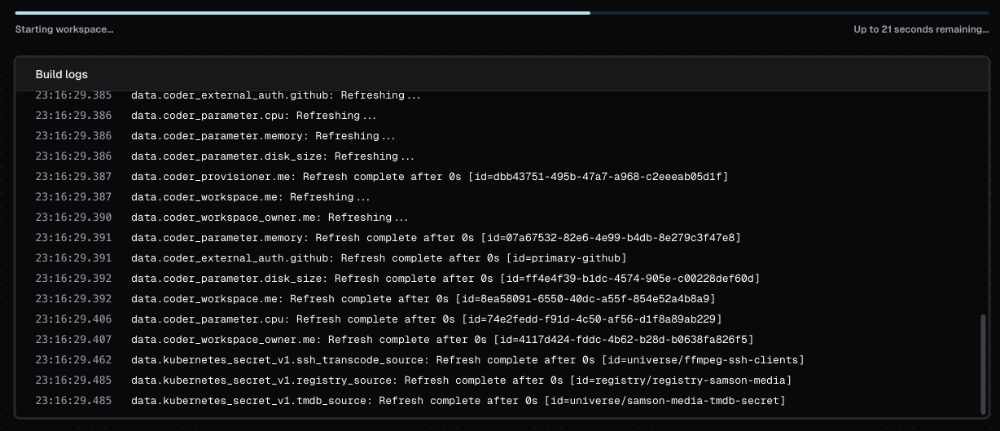
I click "create workspace", pick the template, and roughly five minutes later I have a clean, reproducible environment with everything connected.
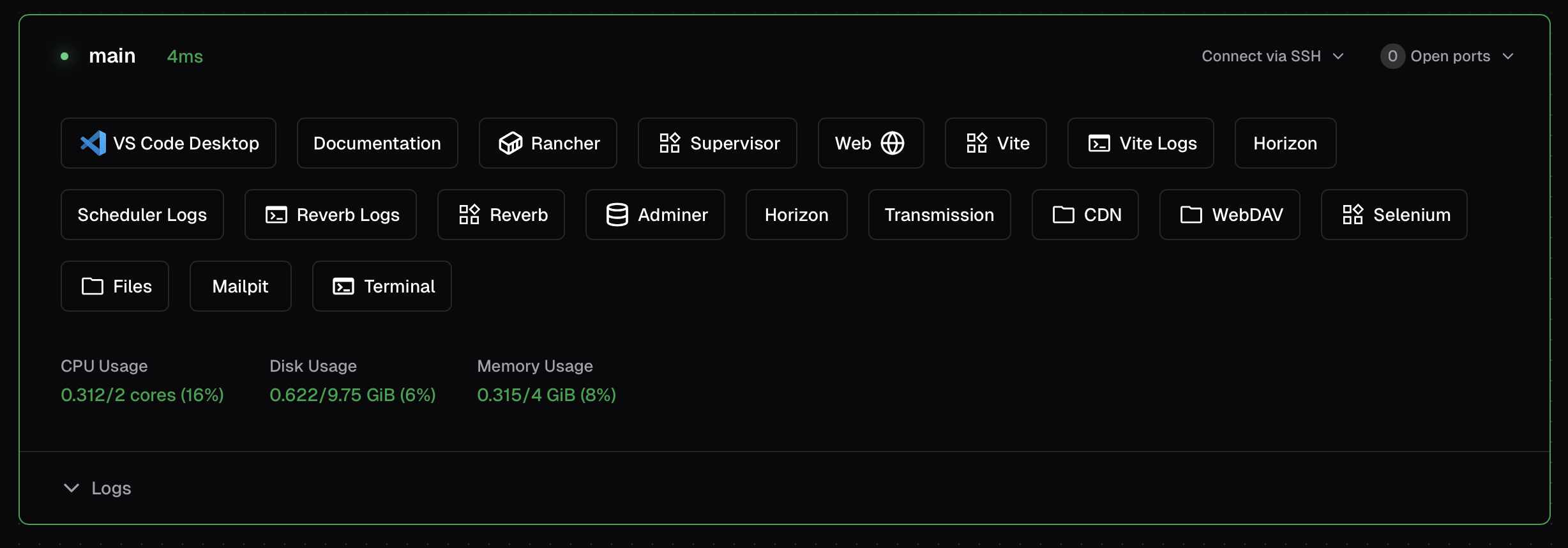
It opens straight in VS Code or IntelliJ through Coder's IDE integration — no hand-rolled SSH config, no "works on my machine", no fortnight-long hunt for the right packages. When I'm finished I throw it away, and the next one is another five minutes. There are no pets, only cattle.
The difference is templating and ownership
The corporate box was hand-built, by hand, by committee, one ticket at a time. My Coder workspace is defined once, versioned, and instantiated on demand. The environment is a build artefact, not a bespoke creature assembled over six weeks of approvals. Change the template, rebuild, everyone's on the new baseline — instead of a wiki page titled "Dev environment setup (47 steps)" that's been subtly wrong since 2023.
It isn't about scale
Here's the bit that stings. I'm one person. They're a company with a whole IT department. And the one-person setup onboards faster by orders of magnitude — not because my hardware is better, but because the environment is codified and self-service rather than gated behind a queue of human approvals. Six weeks of latency isn't a security posture; it's a process problem wearing a security lanyard. Self-service environments don't have to mean less control — Coder still sits on infrastructure I own, with templates I govern. They just remove the humans from the critical path of "I would like to start working now".
On my first real day with the corporate Linux box, muscle memory had me reaching to spin up a Coder workspace instead. I genuinely miss it. The single best productivity feature any team can ship is a dev environment you can create yourself, in minutes, that opens in the editor you already use.